I
have crossed another adventure from my bucket list this year.A movie buff from way back, I’ve watched
"Lawrence of Arabia" many years ago and ever since, I have dreamt of going into
the desert riding a camel.I recently realised
this dream when I visited Zagora; a small town in Morocco’s South.As I began to gather some information on
Zagora, I found out that some of the scenes of that famous movie had been shot in
that region.My planned desert trek suddenly
became that much more exciting.I simply
loved the time I spent there.
The town of Zagora sits at
the foot of the Atlas Mountains and on the shore of the Draa Valley in South
Eastern Morocco.It is flanked by the
mountain Zagora from which the town got its name. The ancient name of the town was “Draa,”
alluding to the valley.Not until the
twentieth century was the town renamed Zagora although some Bedouins still
refer to the town as “Draa".
Daniel's Food and Wine Tours - Stop over before arriving at Zagora - Morocco
Daniel's Food and Wine Tours - Round-about at Zagora - Morocco
Zagora
boomed in the eleventh century when the Almoravids built an imposing fortress
that protected the town against outside aggression for many centuries.As the city of Zagora is over 700m in
altitude, it is a little less scorching here than in neighbouring towns.It is still an arid climate however; with
summer temperatures reaching 35°C to 42°C, and middle of winter temperatures
getting down to -10°C at night.
Daniel's Food and Wine Tours - Locals resting in a street, Zagora - Morocco
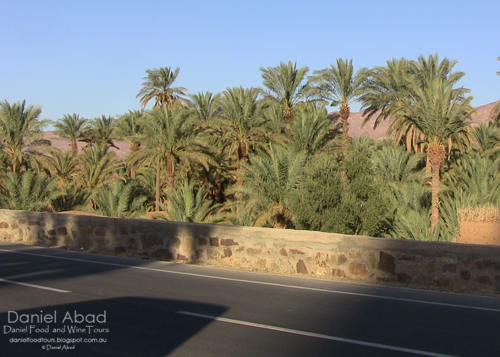
The Draa Valley is a considerable resource for
the hundreds of families in Zagora.Millions of palm trees grow and produce dates each harvest season.The date sector plays an important role in regional
development, providing Morocco, and overseas countries with various kinds of this
delicious fruit.
Daniel's Food and Wine Tours - Date Palms all around, Zagora - Morocco
Zagora and the region is now home of several
ethnic communities including black African groups who emigrated from
Sub-Saharan Africa, along with clans from the Caravans which have emerged and
co-existed since the first Saadyin dynasty.Arabs have also settled in Zagora, coming from Marrakech since the
medieval times.Today, most of Zagora’s
residents live either as field workers in the oases of Draa, or in the tourism
industry, while a few others are state employees working in public institutions.
Daniel's Food and Wine Tours - A local man chatting with the tourists, Zagora - Morocco
A camel trek in Zagora is the experience of a
lifetime. This activity involves riding
camels while exploring the breath-taking desert sights and the warm hospitality
from the locals.
Daniel's Food and Wine Tours - The Caravan waiting to take us to the Desert, Zagora - Morocco
I took a two-day track to Zagora which took me from Marrakech to the barren and spectacular Atlas mountains on to Ouarzazate and then Zagora where camels or should I say dromedaries were waiting to take the group I was travelling with to the edge of the mighty Sahara Desert.
Daniel's Food and Wine Tours - My assigned mode of transport
Daniel's Food and Wine Tours - Interesting feet of the Camel as they are feet not hooves!
Daniel's Food and Wine Tours - Camel tracks on the ground
Daniel's Food and Wine Tours - Heading to our overnight camp in the Desert
At the overnight camp, we were greeted with the
traditional mint tea and allocated our tents for the night.We enjoyed a delicious dinner of hot soup,
tagine, and fresh fruit.After the meal,
we sang and danced to the sounds of Berber drums and songs late into the night.
The next morning, before returning to Zagora, we watched the sun rise over the dunes. I had never experienced the miracle of nature as intensely as I did that morning.
Soon after, we rode back to Zagora where our bus
was waiting to take us back to Marrakech by the evening.
I simply could not tell you what I have most enjoyed
out of this magic trek.The scenery, the
local hospitality, the history of the place, the architecture, the desert, the
cranky but so adorable and tenacious dromedaries, the food, the sounds, the
smells, the music.
Daniel's Food and Wine Tours - Sunrise in the Desert
Daniel's Food and Wine Tours - The Dunes of the Mighty Sahara Desert
Everything combined made this trip an unforgettable experience which I highly recommend to anyone willing to discover something totally different and unexpected.You simply must go there; you will love it.
Ouarzazate was the first
stopover on my trip to the desert.I
left Marrakesh one morning with another ten or so fellow travellers and headed
south to the town of Zagora.After a few
hours’ drive and having crossed the cold and wind-swept Atlas Mountains, we
enjoyed a stopover and a visit of the Old Ouarzazate and a well-deserved lunch.
Daniel's Food and Wine Tours - The mighty Atlas Mountains
Daniel's Food and Wine Tours - Pottery for sale on the side of the road
Daniel's Food and Wine Tours - Isolated houses and cultivation fields on our way to Ouarzazate
Daniel's Food and Wine Tours - Local pottery for sale
Ouarzazate,
nicknamed the “Doorway to the Desert”,
is a city in south-central Morocco.It
is located at 1,200 metres above sea level in the middle of a bare plateau
south of the High Atlas Mountains.To
the south of the town is the desert.The
name Ouarzazate comes from a Berber phrase meaning "without noise" or
"without confusion".As in
many cities around the world, there are two districts in Ouarzazate, the Old
and the New.That day, we visited the
old district and left the discovery of the new section of the city upon our
return from Zagora and our desert trek.
The town is chiefly inhabited by a Berber-speaking
population, who constructed many of the prominent Kasbahs and buildings for
which the area is known. Ouarzazate is
an important holiday destination in Morocco and a base for excursions across
the Draa Valley and into the desert.
Daniel's Food and Wine Tours - Mud bricks used for the buildings inOuarzazate
Daniel's Food and Wine Tours - Shop keeper and her merchandise of beautiful vibrant clothing
Also Nicknamed “Ouallywood” the Ouarzazate
area is a noted film-making location, with Morocco's biggest studios inviting
many international companies to work there.Films such as Lawrence of Arabia, The Last Temptation of Christ, The
Mummy, Romancing the Stone and Gladiator to name a few were shot there, as was
part of the TV series Game of Thrones.
Daniel's Food and Wine Tours - Sign indicating where some of the scenes from Gladiator were shot
Daniel's Food and Wine Tours - Part of an Egyptian Temple at the Movie Studio - Ouarzazate, Morocco
Daniel's Food and Wine Tours - A street in the Studio - Ouarzazate, Morocco
Many directors have held an obsession with the
beautiful range of landscapes and locations which are in easy reach.These include Orson Wells, Ridley Scott, and
David Lean.Any movie buff and I count
myself as one simply could not have gone there and not visited the
studios.What a magical place!!From narrow streets in the souk; Egyptian
chariots to jet planes and more, everything was there to let your mind wander
and marvel at the magic of movie-making.I had a wonderful time there.
Daniel's Food and Wine Tours - Jet plane used for Romancing the Stone...I think?
Daniel's Food and Wine Tours - Part of a Buddhist Temple at the Studio - Ouarzazate, Morocco
Daniel's Food and Wine Tours - Ancient piece of machinery at the Studio
The new, more recent, and modern section of
Ouarzazate caters for its population increase but also for the growing number
of tourists requiring a wide range of services when visiting the area.
The area is also known for its Ouazguita carpets
with geometric designs of red-orange on black background.The city was part of the route of the 2006
and 2007 Dakar Rally.
Daniel's Food and Wine Tours - Carpets for Sale
Daniel's Food and Wine Tours - Rugs and Carpets for Sale - Ouarzazate, Morocco
Daniel's Food and Wine Tours - Carpet Merchants waiting for the tourists - Ouarzazate, Morocco
The main reason for spending time in Ouarzazate is
its prime location for many day trips and overnight excursions to oasis valleys
and the Sahara Desert.After a
well-earned break and a delicious lunch, the next stop was to be Zagora and the
camel trek that was to take the group to the overnight camp in the desert.I had waited a long, long time for this
moment.
The day after
returning from the magical island of Lanzarote, I was again off, this time to
Morocco and the fairy tale city of Marrakesh.I knew very little about Morocco and my last visit to this country goes
back to the mid-sixties when, once a year, my parents drove to Fez from Algeria
to visit my mother’s sister.I landed in
Marrakesh late one evening and was absolutely bowled over by the impressive new
airport facilities, the efficiency of the airport personnel and customs
officials.
Daniel's Food and Wine Tours - The Airport Arrival Entry Area
Daniel's Food and Wine Tours - Just out of the Airport
A
taxi took me from the airport to the Medina, my hotel.On the way, we drove through magnificent, wide,
and well-lit avenues lined up with modern buildings, a testimony of the new
look Marrakesh.I soon arrived at the
Medina and now, the real Marrakesh was waiting for me.
Daniel's Food and Wine Tours - The Wide Avenues of the New Marrakesh
Daniel's Food and Wine Tours - A Garden at the New Marrakesh
Marrakesh, also
known by the French spelling Marrakech
is a major city of the Kingdom of Morocco. It is the fourth largest city in the country,
after Casablanca, Fez and Tangier. Located to the north of the foothills of the
snow-capped Atlas Mountains, Marrakesh is possibly the most important of
Morocco's four former imperial cities (cities that were built by Moroccan
Berber empires). The region has been
inhabited by Berber farmers since Neolithic times.The actual city was founded in 1062.
Daniel's Food and Wine Tours - The Atlas Mountains. No snow that Day
Daniel's Food and Wine Tours - The Old Part of Marrakesh
The red walls of the city which stretch for some
19 kilometers around the medina were built by the Almoravids in the 12th
century as protective fortifications.The
walls are made of a distinct orange-red clay and chalk, giving the city its
nickname as the "red city". They stand up to 5.4 metres high and have 20
gates and 200 towers along them.Marrakesh,
also known as "the Daughter of the Desert " grew rapidly and established
itself as a cultural, religious, and trading centre for the Maghreb and
sub-Saharan Africa.After a period of
decline, the city was surpassed by Fez, but in the early 16th century,
Marrakesh again became the capital of the kingdom. The city regained its pre-eminence with
sumptuous palaces such as the Bahia Palace.
Daniel's Food and Wine Tours - The Red Walls of Marrakesh
Daniel's Food and Wine Tours - Courtyards of the Bahia Palace
Like many Moroccan cities, Marrakesh comprises
an old fortified city packed with vendors and their stalls at the medina.Today, it is one of the busiest cities in
Africa and serves as a major economic centre and tourist destination. Marrakesh is particularly popular with the
French, and a number of French celebrities own property in the city.
Daniel's Food and Wine Tours - Silverware Shop at the Medina
Daniel's Food and Wine Tours - Leather Goods at the Medina
One of the most famous French expatriates
was at the beginning of the 20th century the artist Jacques
Majorelle who built the now world-famous Jardin Majorelle.A few decades later, the illustrious fashion
designer Yves St Laurent purchased and restored the Majorelle property and
settled in Marrakesh.Yves, like Jacques
drew a lot of inspiration for his creations from the colours and the intensity
of the light in Marrakesh.The garden,
open to the public since 1947, has a large collection of plants from five
continents.
Daniel's Food and Wine Tours - Bamboo Alley at the Jardin Majorelle
Daniel's Food and Wine Tours - One of the Many Green Spaces at the Jardin Majorelle
Next to the Jardin, the 4000
m2 Musée Yves St Laurent features a permanent exhibition highlighting 40 years
of the designer’s work.The collections
are housed and safeguarded in a custom-designed space to ensure that the
highest conservation norms for these priceless pieces are applied.Unfortunately, no photos or videos were
allowed so you’ll just have to take my word for it.It was the first time I saw some Haute
Couture pieces.The fabrics, the
colours, the jewels and the accessories; the visit was fascinating.
Daniel's Food and Wine Tours - The Yves St Laurent Museum at Marrakesh
Daniel's Food and Wine Tours - Art Work at the Y.S.L Museum
Daniel's Food and Wine Tours - Coloured Glass Windows at the Y.S.L Museum
Daniel's Food and Wine Tours - French Actress Catherine Deneuve - Yves' Lifelong Friend
Marrakesh has the largest traditional market in
Morocco, with numerous souks selling wares ranging from traditional
Berber carpets to consumer electronics. Crafts
employ a significant percentage of the population, who primarily sell their
products to tourists. Marrakesh is one
of North Africa’s largest centres of wildlife trade, despite the illegality of
much of this trade. Most of these items
can be found in the medina and adjacent squares. Tortoises are particularly popular for sale as
pets but Barbary macaques and snakes can also be found.
Daniel's Food and Wine Tours - A Busy street in One of the Many Souks in Marrakesh
Daniel's Food and Wine Tours - Incense and Other Minerals
Daniel's Food and Wine Tours - Medicinal and Culinary Herbs
Daniel's Food and Wine Tours - Traditional Shops at the Souk
During the early 20th century,
Marrakesh underwent several years of unrest. The country was plagued by anarchy, tribal
revolts, the plotting of feudal lords, and European intrigues. In 1907, Dr. Mauchamp, a French doctor, was
murdered in Marrakesh, suspected of spying for his country.France used this event as a pretext for
sending its troops. On 30 March 1912,
the French Protectorate in Morocco was established until the independence of the
country and the reestablishment of the monarchy in 1956.
The historic wealth of the
city is manifested in palaces, mansions and other lavish residences. Riads (Moroccan mansions) are common
in Marrakesh. Based on the design of the
Roman villa, they are characterized by an open central garden courtyard
surrounded by high walls. This
construction provided the occupants with privacy and lowered the temperature
within the building.Many riads have
been converted into hotels for the growing number of tourists who come to visit
the city all year round.
Daniel's Food and Wine Tours - Narrow Street Leading to my Riad
Daniel's Food and Wine Tours - Riad Jennah Rouge
Daniel's Food and Wine Tours - The Breakfast Area at the Riad
Daniel's Food and Wine Tours - Stairs Leading to the Various Floors of the Riad
Moroccan cuisine is often reputed to be some of the
best in the world, with countless dishes and variations proudly bearing the
country's colonial and Arabic influences.Surrounded by lemon, orange
and olive groves, the city's culinary characteristics are rich and heavily
spiced but not hot, using various preparations of Ras el Hanout (which means
"Head of the shop"), a blend of dozens of spices which include ash
berries, chili, cinnamon, grains of paradise, monk’s pepper, nutmeg and
turmeric.
Daniel's Food and Wine Tours - Commonly Used Spices in Morocco
Moroccans often elect to begin their meals with
warming bowl of Harira a delicious soup made from lentils, chick peas, lamb
stock, tomatoes, and vegetables.Soups
are also traditional breakfasts in Morocco.Bissara,
a thick soup made from split peas and a generous wallop of olive oil can be
found bubbling away near markets and in medinas in the mornings.
Couscous made from steamed
semolina grains is the staple food for most Moroccans and is probably the best
known Moroccan meal.It can be served as
an accompaniment to a stew or tagine,
or mixed with meat and vegetables and presented as a main course.
Daniel's Food and Wine Tours - Couscous of Lamb, Vegetables and Beef
Daniel's Food and Wine Tours - Another Version of the Moroccan Couscous
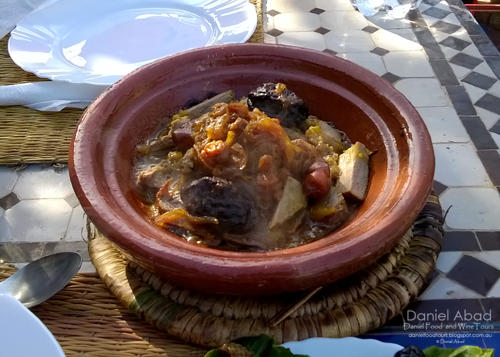
A specialty of the city and
the symbol of its cuisine is a tajine
prepared with beef meat, spices and slow-cooked for many hours
in a conical clay pot.There are dozens of variations, including chicken
with lemon and olives, honey-sweetened lamb or beef, fish or prawn in a spicy
tomato sauce.Another version of the tajine includes vegetables and chickpeas seasoned
with flower petals.
Daniel's Food and Wine Tours - Tajine with Meat and Dates
Daniel's Food and Wine Tours - Tajine Pots
A pastilla is a filo-wrapped pie stuffed with minced chicken or pigeon that has been prepared with almonds, cinnamon, spices and sugar.
Daniel's Food and Wine Tours - Meat and Vegetable Pastilla
Daniel's Food and Wine Tours - Pastilla with Roasted Capsicum, Pumpkin and Eggplant
The Moroccan tea culture is widely
practiced in Marrakesh; green tea with mint is served with sugar from a curved
teapot spout into small glasses. Sweet
pastries are often served with the tea.These are mainly made with flour, semolina almonds, dates, figs, and are
covered with lashes of honey.
Daniel's Food and Wine Tours - A Refreshing Cup of Mint Tea and Sweet Pastries
Daniel's Food and Wine Tours - Delicious Sweet Pastries
Another popular non-alcoholic
drink is orange juice. Under the
Almoravids, alcohol consumption was common; historically, hundreds of Jews
produced and sold alcohol in the city. In the present day, alcohol is sold in some
hotel bars and restaurants.
Daniel's Food and Wine Tours - Orange Juice with Bread and Tomato Concassee
I
enjoyed my stay in Morocco immensely.I
however have felt almost harassed by a portion of the local population whose
main objectives seems to draw as much cash as they possibly can from the
tourists.
When
purchasing anything in Morocco, and especially in the Medina souks and shops,
it is imperative to bargain and bargain hard regardless of the nature or value
of the item.When given a price for
anything, simply half the price and go from there.Never settle for more than 65% of the initial
price or you will be taken for a ride.A
lot of beggars will approach you for a donation.This is up to you to decide who will benefit
from your generosity.
Other
than this, the Moroccan people are really friendly and their welcome is second
to none.I enjoyed the hustle and bustle
of the Medina, the magnificence of its palaces, the smells of the spices, the
colours all around and the delicious foods.I had a truly wonderful time there.