Showing posts with label Oran. Show all posts

Wednesday, 10 June 2015

Tlemcen

Tlemcen is a city in north western Algeria with an actual population of approximately 200,000 people.  It is located sufficiently inland to avoid the humidity of the coast but near enough to receive cooling sea breezes in summer. 


The City of Tlemcen - View from the Observatory


Until the independence from France in 1962, Tlemcen was a vacation spot and retreat for French settlers in Algeria, who found it to be far more temperate than Oran or Algiers.

Some of the Ornate Architecture in Tlemcen
 
The city boasts a prosperous leather, carpet, and textile industry, and it exports these goods to many parts of Algeria and neighbouring countries.  Centuries of a rich history and culture have made Tlemcen the centre of a unique blend of music, art and architecture.  The Great Mosque at Tlemcen was completed in 1136 and is said to be the most remarkable remaining example of Almoravid architecture.

Shady Street in Tlemcen

Tlemcen was founded by the Romans in the 2nd century as a military outpost. During the Middle Ages, Tlemcen served as a trading city connecting the "coastal" route across the Maghreb with the trans-Saharan caravan routes.  It also housed a European trading centre which connected African and European merchants.  At the peak of its success, in the first half of the fourteenth century, the city became the principal intellectual centre of the central Maghreb.  Tlemcen has more buildings dating from the 12th to the 15th century than any other town in Algeria. 

 
Located in Tlemcen itself, the ruins of the Mansourah are a vestige of an ancient city dating back to the thirteenth century.  Today only partial ruins of this magnificent citadel stand and this place has become one of the main tourist attractions of the city.  Walking through this historic site gives you a real feeling of its glorious past history.  

The Entrance of the Mansourah Citadel

The central tower at the Ruins of the Mansourah Citadel

The Walls of the Mansourah Citadel
 
During the early years of the French occupation, a broad coalition of natives at Tlemcen continued to resist the latest invaders and the great Berber leader Abd el Kader, fought with incredible valour.  His defeat in 1844 temporarily ended the dream of an independent Algeria.


A more recent building, the Abou Bekr Belkaid university has eight faculties and ranks among one of the best in the country.  Long considered as the centre for the Arts and Culture, the university attracts a large number of students from all over the country.   

The Entrance of the Tlemcen University
 
The Plateau Lalla Setti rises over 700 feet to the south of Tlemcen and overlooks the whole city.  The architecture, the view of the city below and the many fountains all make this place a must to visit.   


The Tlemcen Observatory tower at the Plateau Lalla Setti
 
Cable Car Arriving at the Observatory


http://danielfoodtours.blogspot.com.au/

Monday, 8 June 2015

Oran

Oran is a major city on the north-western Mediterranean coast of Algeria, and the second largest city of the country.  It is located 432 kilometres from the capital Algiers.   It is a major port and the commercial, industrial, and educational centre of western Algeria.  The city has a population of about a million people and a regional population of approximately double that amount, making it the second largest city in Algeria.

General View of Oran
 
The name Oran comes from the Arabic word "Wahran" meaning two lions.  The legend says that around the 10th century, there were still lions in the area.  The last two lions were hunted at a mountain near Oran now called "La Montagne des Lions (Lions Mountain"; hence the presence of two lion statues outside the city hall in the Place du 1er Novembre.

The Lions' Mountain in the background

The Lions at the Entrance of the City Council Building


The City Council Building 

During the Roman Empire, the area of Oran was a small settlement, which disappeared after the Arab conquest of the Maghreb.  Oran was founded in 903 by Andalusian merchants as a base for trade with the North African hinterland.  It developed its commercial potential owing to its sea connections with Europe.  It was captured by the Spanish in 1509 and that sovereignty lasted until 1708, when the city was conquered by the Ottomans. Spain recaptured the city in and sold it to the Turks in 1792.  The Ottoman rule lasted until 1830, when it fell to the French.

During French rule, until 1962, Oran was the capital of the département of Oranie.  Before the Algerian War, (1954–1962), Oran had one of the highest proportions of Europeans of any city in North Africa.  Shortly after the end of the war, most of the Europeans living in Oran fled to France.  In less than three months, Oran lost about half its population.

The Famous "Boulevard Front de Mer" facing the Port of Oran
 
Oran was one of the principal objectives in the Allied landings in North Africa and was occupied by U.S. forces on 10 November 1942.  At the time of the Algerian independence in 1962, Oran’s naval functions had gradually lapsed in favour of commercial ones.


The Commercial Port of Oran
 
The city is the setting for the French writer Albert Camus’ Novel’s novel “La Peste” (The Plague) written in 1947.  Yves Saint Laurent was born there in 01 August 1936.

Oran's Opera House was built in 1908 and restored in 2008.  It was modelled on the one in Paris and during the French occupation, it hosted some of the biggest French and foreign entertainment acts.  Now as then, the opera has retained its function as the entertainment centre of the city and the region.  Located on the Place du 1er novembre; formerly the Place d'armes, the opera has retained all its majesty.  I was able to visit that place in 2014 and marvelled at its architecture and grandeur.  

The Opera House in Oran

Inside the Opera 

Another imposing building in Oran is the former cathedral; now the city's library.  A number of churches in Algeria were reconverted to mosques after the 1962 independence but the Oran cathedral became a library instead because it was not facing in the direction of Mecca.  


The Cathedral - Now a Library
This is the high school where I studied for 5 years before leaving Algeria.  Going back there brought back a lot of memories of my youth and all the friends I had made during those years.  I have kept in touch with some but lost touch with most of them.

The High School I Attended


Wednesday, 3 June 2015

Mers-el-Kebir

Mers-el-Kébir is the town in Algeria where I was born during the French occupation of that country.  It is a coastal town with a magnificent harbour, located on the Gulf of Oran on the west coast of Algeria. Originally a Roman port, it has a long history of maritime importance. At the end the 15th century. It was a centre of activity for pirates and was twice occupied by the Portuguese. The Spanish held the town from 1505 to 1792.  In 1830, the French arrived and renamed it Saint André de Mers-el-Kébir.
Mers-el-Kébir in the late Fifties/early Sixties
  
The Naval Base in 1953

The Harbour today and Mers-el-Kébir in the background  
 
During World War II, following the German defeat of France in 1940, part of the French fleet sailed from Toulon and took refuge in Mers-el-Kébir.   On the 3rd of July 1940, in order to prevent the French fleet from falling into German hands, the British Royal Navy led by Vice Admiral Sir James Somerville attacked the French Navy fleet.   The raid resulted in the deaths of 1,297 French servicemen; about 350 wounded, the sinking of a battleship and the damaging of five other ships.  This attack, part of Operation Catapult is also known as the Battle of Mers-el-Kébir. 


Le Cuirasse Bretagne

During the Bombardment
A great deal of debate has taken place over the motivations of the British.  London's point of view was that:
“The times were desperate; invasion seemed imminent; and the British Government simply could not afford to risk the Germans seizing control of the French fleet.  The predominant British motive was dire necessity and self-preservation.”
The French on the other hand, thought they were acting honorably in terms of their armistice with Germany and were fully convinced they would never turn over their fleet to Germany. French grievances over what they considered a betrayal by their ally have festered for generations.


The Bombardment
 
My father who was 15 at the time recalled this event on many occasions throughout his life.  The military section of the Mers-el-Kébir cemetery is an eerie reminder of a tragic episode in World War II history.

The Military Cemetery of Mers-el-Kébir
 
After the war, the great French naval base at Mers-el-Kébir came to include a sophisticated subterranean installation in view of a possible nuclear attack.  In 1962 the Evian Agreement, by which Algerian independence was acknowledged, allowed France to remain there for an additional 15 years.  The French however, evacuated the base in 1967.

 
The Construction of the Anti-Nuclear Subterranean Installation


The Subterranean Installation
 

This photo was taken during one of my first visit to Algeria.  It was a very emotional moment for me, posing there after an absence of almost half a century.

The Entrance of the Town
 
This is one of the buildings my grandfather owned in Mers-el-Kébir.  This building housed 14 apartments which my father managed.  I spent my whole childhood there until we left the country to go and live in France. 
My grandfather's apartment building

I spent most of my Primary School years in this building.  Once I reached High School, I continued my education in Oran as Mers-el-Kébir didn't provide secondary level education. 
My Primary School


Friday, 29 May 2015

People

I have selected some of the images I have taken during my travels to Algeria.  I love going about in the streets, watching people going about their daily lives.  My camera is always ready whenever someone catches my attention.

Everywhere I go, I am always greeted with a smile and a ready willingness to pose for me and let me take a photo.  To all these wonderful people, my gratitude and special thanks.

I took this photo in Ain-el-Turck at lunchtime.  These 3 workers were taking a break and were eating some Calentica served on bread as a sandwich.  Calentica is a popular food that I have described in the Food section of the blog posts on Algeria.
3 workers at Lunchtime
This lady was resting under the shade of a tree at a popular tourist lookout called "Bel Horizon".  It was lunchtime on a hot autumn day.
A Lady by the Shade of a Tree
You can see many of these merchants in the streets of Oran.  In this case, this fellow was selling assorted nuts such as peanuts, almonds, pistachios, pumpkin seeds etc...  Note the inventive way this fellow has set up his platform; and old pram, a wooden plank, some boxes and his produce and he's got his business going. 
A Street Merchant
I was taken by this man sitting by a shady street.  His face and eyes were so peaceful and gentle and he was quite happy to let me take his photo.
A wise Man
This elderly gentleman was resting near what used to be the picture theatre in Mers-el-Kébir.  These days, it is a government building.
Elderly Gentleman  Resting
The Kristel market is one of my favourite places where I have made and enjoy catching up with a number of friends I now have there.  
Farmers and their Produce at the Kristel market
 
This little boy was standing at the window in his house and was quite happy to pose for me. 
Hello Little Man
I couldn't resist the opportunity to take this photo at the main entrance of the El Mansourah citadel.  The ladies were most obliging and even the horse co-operated in this instance.
Ladies by the Entrance of the Ruins of El Mansourah
I was visiting the house where the nuns of Mer-el-Kébir used to live when this little cutie suddenly came out of one of the rooms.  Her smile and genuine happiness did it for me.
Little Cutie
I took this shot near a market in Oran.  He was sitting there and was more than happy to let me play with my camera.
Man Sitting
These 4 men were watching the world go by at a village near Mers-el-Kébir called El Ançor. 
Whenever they can, locals spend a good part of the day talking and exchanging ideas.  This practice reinforces the bonds between them and keeps the true value of Life foremost in their mind.
Men at the Town Square
These 2 men were enjoying a coffee break in Tlemcen.  As well as sweet Mint tea, a great deal of coffee is consumed every day by the local population.
Men enjoying a Coffee Break
This shot was taken in Oran along the boulevard Front de Mer facing the port of Oran.
Men Exchanging Ideas
Each time I travel to Algeria, I go and visit a family who now lives in the house where I grew up when I was a boy prior to leaving the country to go to France.  Mother and daughter are standing in what used to be my parents' bedroom.
The Family who lives in the Apartment where I Grew up
The year I visited my primary school, the building was closed for holidays.  The cleaners were however inside and were quite happy to open for me and let me visit the place.  I hadn't seen this place for nearly half a century but all my childhood memories were still there.  As a bonus, they agreed to pose for me; thank you ladies for a very special moment. 
The Primary School Cleaning Ladies
These young girls were walking in the streets of Mers-el-Kébir and were curious to know who I was and what I was doing in their part of the world.  There again, I had to take a shot.
Three Young Girls
These 2 young men were caught in a traffic jam as I was walking by in one of the main streets in Oran.  They called out and simply wanted to welcome me in their country.  Their exuberance caught my attention and the camera did the rest. 
Welcoming Smiles from the Locals
These 2 young boys were standing in front of the mosque at Mers-el-Kébir; formerly the catholic church of the village where I had been an altar boy for 8 years.  I stood in this very spot countless times while I lived there and decided it was worth a shot. 
Young Boys by the Mosque
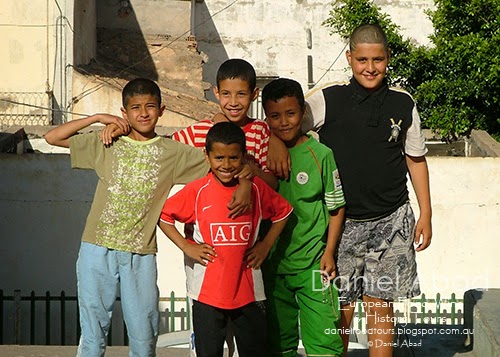
The youth population of Algeria is very high and wherever you go, young people can be seen everywhere.  They spend most of their time at school and when school is over, the street is their playing ground.  No computers, I pads and other electronic devices to occupy their day but plenty of physical exercise and fresh air.  Obesity is practically non-existent and just take a look at those smiles !!!  
Young Boys in the street
This young girl kept watching me by the door of her house as I walked down her street in Mers-el-Kébir.  She gratefully posed for the camera.
Young Girl at the Door
This young man was transporting all sorts of things on his cart with his donkey.  I loved the scarves around its head and when I asked him the reason for these, he simply replied that he thought it looked good.  I agreed with him and took the photo.
Young Man and his Donkey