One of my passions in Life has always
been Food. I love eating it but most
importantly, I want to know where it comes from, how it was grown, how it was
cooked and who cooked it. Cooking methods are very important
to me and I love watching people preparing their food, asking them why they do
it in such a way; find out where these recipes come from and who handed them down
from one generation to the next.
Algerian food is very healthy and
very fresh. In the part of the country that I travel to, seafood plays an important part in the population’s diet. Anything from sardines, to prawns, red mullet, groper, langoustines, squid, cuttlefish, tuna, bonita and other abundant seafood is sold on the streets or in shops. Daily arrivals of this commodity is kept cold on ice and the freshness of that produce is second to none.
I was driving through Ain-el-Turck one day with my friend Kader and saw a fishmonger on the footpath with two trays of freshly-caught sardines. I couldn't resist the idea of sardines for lunch so we stopped and picked some up. We went back to my friend's place and enjoyed a succulent meal of fried sardines. To prepare these, you simply take their insides out, roll them in salted flour and shallow fry them in olive oil. Once cooked, you take the whole sardine and eat each side of the fish before discarding the back bone and the head. These can also be baked in an oven and eaten in the same fashion; simply delicious and so fresh.
I was invited to my friend Mohamed's place for lunch one day. His wife had prepared some fried red mullet and merlan in pretty much the same fashion as I described for the sardines. Note the olives that accompanied the fish dish. The red mullet is widely found in the Mediterranean Sea. It is a favoured delicacy in Algeria, and in antiquity, it was "one of the most valued fish for the Romans. The merlan, commonly known to us as whiting, is also an important food fish in the Mediterranean basin.
I bought this lot of red mullet from a fisherman who had just arrived on the beach and was selling his catch. We had these lightly salted, grilled whole and eaten that evening. They were just delicious.
This is one of the many seafood platters that greet you when you arrive at my favourite restaurant in Arzew; "Les Gazelles". That restaurant is located by the water and offers its patrons an uninterrupted view of the sea as you enjoy the many delicacies that the Chef has on offer for you. Seafood of course is the restaurant's speciality and it is cooked in a huge variety of ways. I go the Les Gazelles every year and my favourite dish is oven-baked Groper. A truly delicious treat fit for a king and eaten in a most enjoyable atmosphere and with the greatest outlook.
Fruit and vegetables are also abundant, of high quality and at very affordable prices. The Algerian diet is very healthy and although there is a tendency to gradually move towards more processed foods, especially among the younger generations, the vast majority of the population still enjoys organically grown foods that are low in fats and high in fibre.
 |
| Seafood Shop in Oran |
 |
| Fresh Sardines |
I was invited to my friend Mohamed's place for lunch one day. His wife had prepared some fried red mullet and merlan in pretty much the same fashion as I described for the sardines. Note the olives that accompanied the fish dish. The red mullet is widely found in the Mediterranean Sea. It is a favoured delicacy in Algeria, and in antiquity, it was "one of the most valued fish for the Romans. The merlan, commonly known to us as whiting, is also an important food fish in the Mediterranean basin.
 |
| Fried Whole Red Mullet and Merlan with Assorted Olives |
 |
| A catch of fresh Red Mullet |
This is one of the many seafood platters that greet you when you arrive at my favourite restaurant in Arzew; "Les Gazelles". That restaurant is located by the water and offers its patrons an uninterrupted view of the sea as you enjoy the many delicacies that the Chef has on offer for you. Seafood of course is the restaurant's speciality and it is cooked in a huge variety of ways. I go the Les Gazelles every year and my favourite dish is oven-baked Groper. A truly delicious treat fit for a king and eaten in a most enjoyable atmosphere and with the greatest outlook.
 |
| Seafood Platter at Les Gazelles Restaurant near Arzew |
Local fruit stalls, located on the footpath are a common sight in Algeria. This produce is usually sold by the farmers themselves or a member of the family. In this instance, these organic peaches were grown locally and had been picked straight off the trees that morning. The smell, the flavour and taste of these fruits were a pleasure one seldom can enjoy today.
 |
| Stone Fruit Sold on the Footpath in Ain-el-Turck |
Fresh herbs play an integral part in almost every Algerian dish. The most popular ones are flat-leaf parsley and coriander which people use by the handfuls in their cooking. Mint is also a must in Algerian cooking but also in the traditional sweet tea which is consumed in huge amount by the locals to celebrate any occasion from a meeting with friends at a café to a family reunion or a festive occasion. Stalls selling fresh herbs can be found almost everywhere you go.
Spices also play a major part in Algerian cooking. The most commonly used spices are dried Red Chillies of different kinds, caraway, as el Hanout; a spice mix which plays a similar role in North African cuisine as Garam Masala does in Indian cuisine. Ras el Hanout is used in many savoury dishes, sometimes rubbed on meat or fish, or stirred into couscous or rice. Other spices such as Black Pepper, Cumin, Saffron, Nutmeg, Ginger, Cloves, and Cinnamon are also among the favourite spices you will find in Algerian cuisine. Cayenne pepper, Ginger, Fennel, Caraway, Aniseed, Wild Parsley and Mint are also commonly used. Spices are sold on the streets as well as spice shops and are available in bulk. I prefer buying my spices in shops as they are displayed in more enclosed areas as in open air and one can really appreciate the full tantalising fragrances of the various spices on offer.
In Algeria, olive trees have long been prized for their fruit and its oil. Olives are prepared in a number of tasty ways and served on their own, or as an ingredient in the preparation of certain dishes. Olive production in Algeria is currently expanding and the production and processing of olives and olive oil is being modernised. There are currently 300 000 ha of olive groves in Algeria and, in 2007, the sector produced about 40.000 tones of olive oil and 100.000 tones of table olives. Needless to say that you will always find olives on the table and at every meal. Picked at different stages of maturity, prepared in many different ways and using specific blends of spices and herbs, olives are a must in the Algerian diet. Here again, these are available in bulk and pretty much everywhere you go for your daily food shopping.
In most open-air markets in Algeria, you will find a snail merchant. Snails are commonly used in Algeria and are usually hand-picked in the countryside during rainy periods. As a child, still living in Algeria, each time it rained, my family went to their favourite spots to collect snails. Before they are cooked, the snails must first be prepared by purging them of the contents of their digestive system. To purge a snail, the usual method is a combination of fasting while being kept in a wet environment. These are then blanched in boiling salt water and then cooked in a tasty sauce which has been prepared separately by using onions, garlic, tomatoes, almonds and a wide variety of herbs and spices. Although this kind of preparation is lengthy, the result is well worth the effort and it is a huge improvement on the traditional snails in garlic butter.
Fresh date merchants such as this fellow pictured below are a common sight in the streets of Oran. The dates come from the Sahara which means Desert in Arabic. Date palms can be found in oases throughout the south of the country across the desert region. They are cultivated in 9 Saharan districts, of which the most productive are Biskra, Adrar, El Oued, Ouargla and Ghardaia. Dates are sold fresh and are available as bunches or loose in smaller quantities. They are succulent and so much tastier and juicier than the packaged dates one commonly finds in supermarkets. Algeria used to be Africa’s second largest producer of dates, behind Egypt and the tenth largest exporter of dates by volume in 2010 (according to the UN's Food & Agriculture Organisation). Tunisia today claims the top spot.
I took this photo in Mers-el-Kébir. It had a charm all of its own. As you can see; all that this fellow was selling was eggs. This type of specialised selling is quite common among street sellers who simply concentrate on just offering the shoppers only the one product. Although cars are an ever increasing commodity in Algeria, donkeys are still widely used to transport various items and even people. I loved the VW car hub cap at the back of the cart. It shows that a little imagination can give character to the most humble of contraptions.
I love visiting the local markets, mingle amongst the locals and watch the foods they buy and how they eat them. Supermarkets are still rare in that part of the country. Instead, you will find corner stores where most of the foods such as spices, pulses herbs etc… are still being sold in bulk. In a way, shopping for food over there is like going back in time when things were much simpler and healthier.
Open-air markets are a common sight in Algeria. The Kristel market is one of my favourites and I always stop there on my way to Arzew for lunch at my favourite restaurant "Les Gazelles". Kristel is a small fishing village situated between the cities of Oran and Arzew in the northwest part of Algeria. Local farmers bring their produce every day and the local population enjoys a wide variety of produce and at very affordable prices.
 |
| Fresh Figs |
 |
| A Fresh Herb Merchant in Oran |
 |
| A Spice Merchant in Oran |
In Algeria, olive trees have long been prized for their fruit and its oil. Olives are prepared in a number of tasty ways and served on their own, or as an ingredient in the preparation of certain dishes. Olive production in Algeria is currently expanding and the production and processing of olives and olive oil is being modernised. There are currently 300 000 ha of olive groves in Algeria and, in 2007, the sector produced about 40.000 tones of olive oil and 100.000 tones of table olives. Needless to say that you will always find olives on the table and at every meal. Picked at different stages of maturity, prepared in many different ways and using specific blends of spices and herbs, olives are a must in the Algerian diet. Here again, these are available in bulk and pretty much everywhere you go for your daily food shopping.
 |
| A Fresh Olive Merchant in Oran |
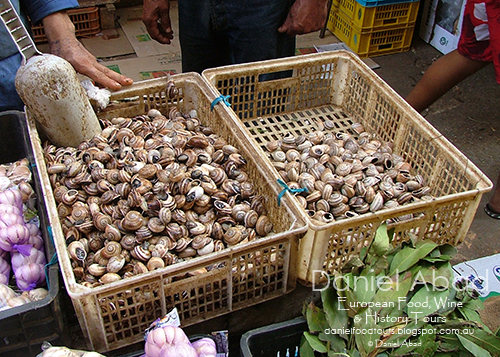 |
| Anyone for Snails? |
Fresh date merchants such as this fellow pictured below are a common sight in the streets of Oran. The dates come from the Sahara which means Desert in Arabic. Date palms can be found in oases throughout the south of the country across the desert region. They are cultivated in 9 Saharan districts, of which the most productive are Biskra, Adrar, El Oued, Ouargla and Ghardaia. Dates are sold fresh and are available as bunches or loose in smaller quantities. They are succulent and so much tastier and juicier than the packaged dates one commonly finds in supermarkets. Algeria used to be Africa’s second largest producer of dates, behind Egypt and the tenth largest exporter of dates by volume in 2010 (according to the UN's Food & Agriculture Organisation). Tunisia today claims the top spot.
 |
| A Fresh Date Merchant in Oran |
I took this photo in Mers-el-Kébir. It had a charm all of its own. As you can see; all that this fellow was selling was eggs. This type of specialised selling is quite common among street sellers who simply concentrate on just offering the shoppers only the one product. Although cars are an ever increasing commodity in Algeria, donkeys are still widely used to transport various items and even people. I loved the VW car hub cap at the back of the cart. It shows that a little imagination can give character to the most humble of contraptions.
 |
| An Egg Merchant Selling on the Street in Mers-el-Kébir |
I love visiting the local markets, mingle amongst the locals and watch the foods they buy and how they eat them. Supermarkets are still rare in that part of the country. Instead, you will find corner stores where most of the foods such as spices, pulses herbs etc… are still being sold in bulk. In a way, shopping for food over there is like going back in time when things were much simpler and healthier.
Open-air markets are a common sight in Algeria. The Kristel market is one of my favourites and I always stop there on my way to Arzew for lunch at my favourite restaurant "Les Gazelles". Kristel is a small fishing village situated between the cities of Oran and Arzew in the northwest part of Algeria. Local farmers bring their produce every day and the local population enjoys a wide variety of produce and at very affordable prices.
 |
| Farmers Selling their Produce at the Kristel Market |
Zlabia is an Algerian pastry which the locals enjoy throughout the year with the traditional Arab sweet mint tea. This delicacy is made by piping and deep-frying a wheat flour batter in circular shapes, which are then soaked in honey or sugar syrup while it is still hot. Zlabia is particularly popular during Ramadan. This delicious sweet gets crunchy once it has cooled and keeps for a few days without refrigeration. As with most Algerian cake shops, the proud display of the pastries plays an important part in attracting the customers.





