Showing posts with label Costa Blanca. Show all posts

Monday, 3 August 2015

Villajoyosa - Spain

Located at the northern end of the Costa Blanca, around 26 kilometres from the city of Alicante, Villajoyosa is a delightful and historic town.  It stretches the length of a wide, sandy beach, with coloured fishing houses running along the seafront against a backdrop of mountains.  Villajoyosa has a rich cultural heritage. Its history as a town dates back to the 6th century.  It has been settled by the Greeks, Phoenicians, the Romans and of course the Moors, when it actually fell into decline.  The town as it is known today was founded in 1293 by an Admiral who served in the Kingdom of Aragon’s navy. Its name Villajoyosa literally means Joyful town.

Throughout the centuries Villajoyosa has been an important trading destination with olive oil, cereals and wine as well as shipbuilding, amongst others.  What it is probably most famous for however is its chocolate.  During the 19th century the town started to develop a chocolate-making industry.  Because of its trade connections, it started importing cocoa from Ecuador and Venezuela and the industry grew and grew.  The chocolate brand, ‘Valor’, which can be found in most shops and supermarkets throughout Spain, comes from Villajoyosa.
The Second Generation of Valor Chocolate Makers
The main reason for my going to Villajoyosa was indeed to visit its famous chocolate factory.  I really wanted to discover that famous factory but most importantly taste its products. 
A sample of some of the Valor Chocolates available to the Public
As one would expect, the Valor factory has a rich history and one of the sections of the building has been allocated to host the impressive chocolat-making machinery and tools from past centuries.  The museum is well appointed and the guided visit most interesting.
A Section of the Museum and the Machinery from the Past

Various Stages of Chocolate-Making - From the Bean to the Final Raw Product 

Cocoa Plants Growing in a Hot House at the Valor Chocolate Factory
We then proceeded to the chocolate-making area of the enterprise but no photos were allowed in that section.  The visit ended with a stop at the shop where all the Valor products were on sale.  The biggest issue at that point was what to choose and how much to buy as everything was so tempting. 
Individual Chocolate Display  Cabinet

The Exit of the Valor Chocolate factory
In addition to its chocolate factory, Villajoyosa offers lots of amenities and facilities; shops, bars and restaurants in abundance, a lively fish market and bustling local market, where you can pick up fresh local produce, home-made local souvenirs and crafts.

Villajoyosa really comes to life for the Moors and Christians festival in the last week of July - a re-enactment of the defeat of the Algerian Pirate Zala Arráez who came to ransack the town in 1538.  For seven days, the entire town dresses up as Moorish pirates or Christian defenders to re-enact the defense of the town.  Spectacular fireworks and lots of delicious food and drinks are available for everyone.

Monday, 27 July 2015

Polop - Spain


The village of Polop is located inland in the Costa Blanca.  The local economy is based mainly on agriculture and a large portion of the surrounding countryside is covered in polythene to act as giant greenhouses.
The Town of Polop
The town is a delight to explore and the hill, where the old castle used to be is encircled by a medieval wall. We wandered the charming streets of Polop for quite some time and by lunch time, we began to search for a place to rest and eat.  We found the Ca Langels restaurant and the look of the place itself was enough to convince us that it would be the place to go.
Ca Langels Restaurant in Polop


The Main Dining Room
Waiting Area Near the Toilets - How Thoughtful

Private Corner of the Dining Room

If the place was inviting. the food was certainly more than complementary.  It was innovative, well cooked, well presented, the service was excellent and friendly and we had a wonderful time in total.
Garden Salad with Marinated Sardines
 
Puree of Leeks
Cabbage and Spinach Crispy Rolls with Quail Eggs on Dark Bread Toast


Eye Fillet of Beef on a Bed of Fried Potato Slices and a Truffle Sauce


Home-Made Orange Cake with a Rum and Raisin Ice Cream and Chocolate Sauce
Polop can easily be combined with the nearby resort of Benidorm.  It provides a perfect contrast to the busy, commercial beaches of Benidorm.  Not far from Polop, you can also explore the historic village of Guadalest which we also visited.


Wednesday, 8 July 2015

Benidorm - Spain

Until the late 1950's, Benidorm was a small village and this is the way I remember that place when my parents went on holidays in Spain in the early 60's.  Today it stands out for its hotel industry, beaches and skyscrapers, built as a result of its tourist-oriented economy. The skyline formed by its numerous tall hotels and apartment buildings is unlike any other on the Costa Blanca (White Coast).  I wet back to Benidorm in 2014 after roughly 50 years and was absolutely amazed by the transformation.
Benidorm Today
Benidorm and its Beaches
                                      View of Benidorm from the Observatory Deck
It is said there were settlements in the Benidorm area possibly as far back as 3000 BC. Settlements in this area were however small and it was not until the arrival of the Moors that the local population began to grow.  The Christian King James I of Aragon reconquered the region in 1245.  Benidorm’s history for the next few centuries was plagued by attacks from the sea by Ottoman and Barbary pirates.
The Observation Deck by the Sea at Benidorm
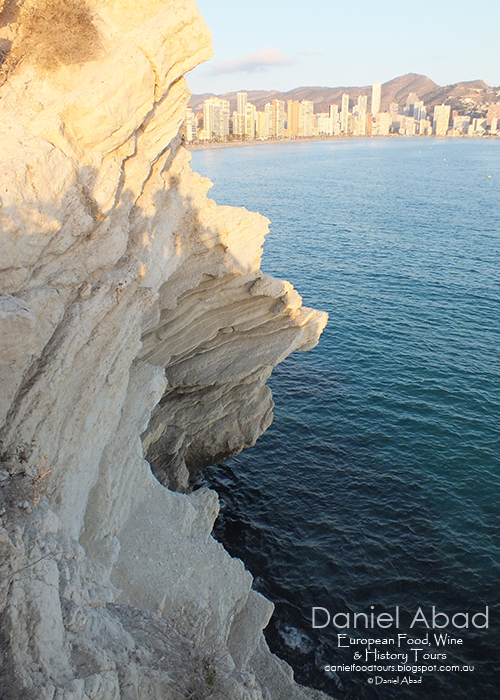
Small Island near Benidorm

This was an interesting formation as it seems that only part of what now forms the island was raised from the sea.
Taking in the Glorious View
 
By the 18th century Benidorm fishermen had become famous.  The success of the fishing industry, together with a growing local agriculture, fuelled a strong local economy.  In the early fifties, Benidorm’s fishing industry went into decline; a factor in encouraging the town council to approve many new development plans aimed at the tourist market.  Today the town is Europe and Spain’s biggest holiday resort and responsible for a significant chunk of Spain’s large tourist industry, with five million tourist visiting Benidorm every year.
The Beach Walkway at Benidorm


We stayed in Benidorm and spent the evening there, window shopping and taking in the sights.  Before returning to my friend's place, we went to a café and had the traditional thick chocolate drink with "Churros"; a type of fried doughnut dough and sprinkled with caster sugar and sometimes cinnamon.  It was delicious. 
Benidorm by Night
The Café where we had our Hot Chocolate and Churros

Monday, 6 July 2015

Alicante - Spain

Of all Spain's mainland provincial capitals, Alicante is the most influenced by tourism, thanks to its nearby airport and resorts.  This is a dynamic and attractive Spanish city with a castle, an old quarter and a long waterfront with an exciting eating scene.
Alicante - View from the Castle
My previous visit to this city goes back to 1965 when still a teenager, I went there on holidays with my parents.  Every second year or so, we spent two weeks in Spain and Alicante was always part of the programme.  Many changes have occurred since then but the city has kept all its charms and it was with a lot of fondness that I revisited the familiar places I hadn't seen for such a long time. 
Alicante


Located in the middle of the Costa Blanca, Alicante with the tranquil waters of the Mediterranean Sea sits at the foot of the Castle of Santa Barbara, a silent witness to the numerous civilisations to have settled there.   
The Castle of Santa Barbara on top of the Hill Overlooking Alicante

The Ramparts at the Castle


You can't miss this impressive castle situated on an outcrop overlooking Alicante City.  It's one of the largest medieval fortresses in Europe and covers the complete summit of the Benacantil Mountain.  Bronze Age, Iberian and Roman artefacts have been found on the slopes of the mountain, but the origins of the castle date to the 10th century at the time of Muslim control of the Iberian Peninsula.

Statue on the Ramparts

Keeping an Eye on the Place
Originally built by the Moors in the 10th century, the castle received its name from the conquest of King Alfonse the Wise that took place on 4th December 1248 on Saint Barbara's day.  The castle was bombarded in 1691 by a French squadron.  During the War of Spanish Succession, it was held by the English for three years.  In 1873, it was bombarded, along with the city.


One of the Castle's Collection Rooms

Tapestry
 

 The Santa Barbara Castle has everything you would expect, cannons, a palace, dungeons, a moat, the ruins of a small church and of course that famous lookout tower.

Cannon with Lots of Stories to Tell
Weaponry from Yesteryear


From all around the walls you get the most fantastic views.  The castle is free to visit and it is an excellent place to visit anytime of the year.
 
 
View of the Alicante Beach from the Castle of Santa Barbara

The Spanish Flag


The coastline is, without a doubt, the favourite recreational spot for the people of Alicante.  The Paseo (Promenade), located across from the port, is a lively boulevard dotted with terraces and pavement cafés.  A more modern area extends along the port's breakwater, where there are also many bars and restaurants.
The Paseo Across from the Beachfront 
La Terraza del Gourmet Restaurant near the Paseo
Ancient Trees Lining the Paseo 
Alicante is also a land of deeply-rooted traditions, such as the Moors and Christians festivities and the Night of San Juan; (The Night of Saint John) on the 24th of June.  The main features of this festivity are the bonfires.  As a tradition, (papier-mâché effigies), which had been exhibited on the street of the capital city during the previous days, are burned at the stake on this night.  The Alicante harbour has a magnificent replica of a Spanish Galleon next to a modern sculpture combining the old and the new.
 

Replica Spanish Galleon in the Alicante Harbour


The Spanish Galleon and the Statue in the Alicante Harbour
 
When it comes to Alicante's delicious cuisine, rice takes the central stage, cooked in a million different ways.  The visit would not be complete without trying the delicious rice dishes, cooked in many different, original ways around these parts: arroz a banda (rice with fish), arroz negro ("black rice", with cuttlefish), arroz al horno (baked rice), etc.  Seafood is also incomparable. 
For dessert, nothing beats Pan de Higo (bread, made with a paste of dried figs), Turrón, (a sweet similar to nougat, made of toasted almonds, honey and sugar) and Jijona ice cream. These dishes go very well with local wines such as Fondillón, an old fruit liqueur, which is excellent for dessert.


Friday, 3 July 2015

Bodega Enrique Mendoza - Alfaz del Pi - Spain

Alfaz del Pi is a town located in the province of Alicante, on the Costa Blanca.  It is situated 47 kilometres north of Alicante.  The town nestles in the foothills of the Sierra Helada.  The town dates back to the Moorish occupation.  The name ‘Alfaz’ derives from the Arabic word for “sown land”, as the region was used to grow fruits and almonds. Later on, the town became a fortified settlement, which protected the local coastline against the Barbary pirates.

The main reason for my going to Alfaz del Pi was to visit the Enrique Mendoza Winery.  This winery was created at the end of the 70’s when its owner Enrique Mendoza became interested in the world of Wine.
The Bodega Mendoza Brand
Today, the first plants have transformed into two wineries; one for the ageing and bottling of the wine in Alfaz del Pi and a second one in Villenal.
The Bottling Plant
In order to make the best possible wines, Mr Mendoza uses grapes from his own vineyard and controls the irrigation of the vines by applying the latest environmental advances and techniques in viticulture.  No herbicides or insecticides are used and the soil is nourished with compost from their own cattle.
Entry to the Winery 
The final touches are given to the wine with an underground ageing facility with controlled temperature and humidity in barrels from the best French and American Oak.

How Oak Barrels are Made 

The Oak Barrels 
For those who wish to visit the winery, a degustation visit is available where you will find out all about the important aspects of the winery, the vines and grapes growing on the estate and of course a comprehensive degustation where you will taste some of the Estate’s best varieties.
The Degustation Area 
The Mendoza wines are made from Chardonnay and Muscat grapes for the white wines and Cabernet Sauvignon, Merlot, Pinot Noir, Petit Verdot, Shiraz and Monastrell for the Reds.
First the White Wines


Then on to the Reds
Altogether, I had a fantastic time and the visit to the winery was well worth the short drive from Calpe where I was staying.
One of the Bodega's Finest 
From Alfaz del Pi, it is easy to visit Alicante, Benidorm, Albir, Denia, Calpe and other seaside towns and villages.  After the visit to the winery, we drove to Benidorm for a totally different scenery.  Benidorm features in another one of my posts from Spain.